
Denmark
Ring Djursland
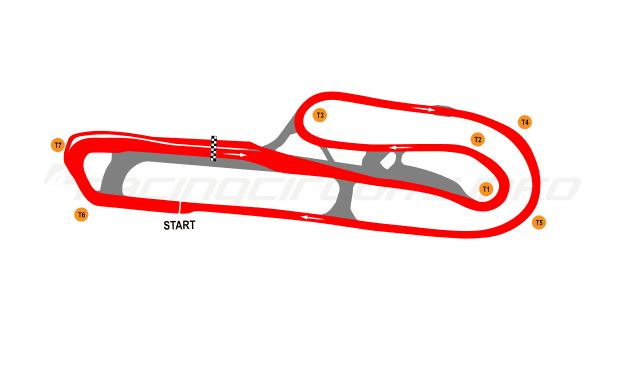
Ring Djursland is a compact and challenging permanent road course located near Tirstrup in Denmark’s Midtjylland region.
The track
About Ring Djursland
Ring Djursland is a compact and challenging permanent road course located near Tirstrup in Denmark’s Midtjylland region. Built on undulating farmland, the circuit features significant elevation changes and a series of technical corners that have tested competitors since the mid-1960s. Despite a turbulent history, the track has endured and now operates alongside driver training facilities, hosting national-level car and motorcycle racing events including the Super GT and TCR Denmark series. From humble origins and tragedy to resilience and reinvention, Ring Djursland’s story is uniquely Danish.
Ring Djursland began life in 1965, born from the vision of Danish racing driver Jens Christian Legarth. Following a serious crash in Hungary, Legarth abandoned his career in Formula 3 and resolved to build a safe, permanent facility for motorsport. After being thwarted by local opposition near his Søholm estate, he eventually secured farmland near the village of Pederstrup, roughly 50km from Aarhus.
The initial 800-metre boot-shaped layout was rudimentary, plotted by driving through wheat fields with friends marking corners. The new venue opened on 29 August 1965, with races organised by Aarhus Automobile Sport. Legarth himself won the first Formula 3 heat in a Brabham BT15 before tactfully yielding victory to Swedish driver Gunnar Pedersen. The event also featured sportscar and saloon races, and was followed by a Danish motorcycle TT finale later that year.
Winter 1965–66 saw the circuit extended to a longer course designed by architect Per Lauritsen. Snow delayed completion, but the new layout opened in April 1966. Thanks to Legarth’s international contacts, the track soon attracted top-level Formula 3 talent, including Frank Williams, Reine Wisell and Ronnie Petersen. A Christmas Day meeting was even attempted, with icy conditions overcome by spreading rock salt.
In July 1967, a further revision introduced a 1.200-mile (1.931-km) layout with an S-bend section, used for a marquee event featuring Jean-Pierre Jabouille, Derek Bell and François Cevert. Tragedy struck during this event when a collision killed American driver Douglas Revson and Legarth himself, who was hit by a spinning car. Five other officials were injured, including Legarth’s wife Annie.
Despite the loss, Annie Legarth kept the circuit running until its sale in 1969 to her father, Gunnar Henriksen. A succession of new owners followed over the next decade, each making changes. Ancher Larsen introduced a motocross course and reversed racing direction for 1970, while René Koors added facilities and supported rallycross events, though he clashed with racers and residents alike over noise.
By the late 1970s, the track had fallen into disrepair. Racing ceased altogether in 1976 but a lifeline emerged via the School of Semi-Skilled Workers, which used the track for technical training. Limited events resumed in 1977, including the return of rallycross. However, deteriorating surfaces forced the Danish motorsport federation to suspend car racing after 1980.
In 1983, the Danish government’s Labour Market Directorate purchased the site, integrating it more formally with driver training. Racing resumed in 1984 following resurfacing. Notable events included EFDA Sports 2000, Formula Ford and international motorcycle racing. The resurfaced track proved slippery at first, but events grew steadily.
A young Tom Kristensen starred in the final event of 1987, taking his first pole position before finishing second in Formula Ford 2000. That same year, the environmental permit lapsed, and racing halted once more. Test events in 1989 helped gather sound data, but it would take until 1994 before racing was fully reinstated.
By the early 1990s, the circuit had been updated with a rebuilt hairpin, new guardrails and spectator embankments. Racing resumed under Aarhus Motor Klub Autosport and, later, Djurslands Motor Klub Autosport, which merged in 1999. A commercial foundation was formed in 2004 to support future development.
That year, a complete resurfacing and new run-off areas were installed, though the asphalt had to be patched overnight during the DTC weekend when it broke up under the power of the DTC cars. Improvements continued with a revised pit entry in 2005, and permanent noise monitoring infrastructure was added to secure local approval.
Today, Ring Djursland hosts four main race weekends annually. With Super GT and TCR Denmark as key fixtures, supported by motorcycle races and a historic racing festival, the circuit has finally found stability. Supported by its dual identity as a motorsport venue and driver education facility, Ring Djursland continues to thrive.

Layouts
Configurations at Ring Djursland
Ring Djursland runs in 4 configurations.
| Layout | Length |
|---|---|
| Full Circuit | 1.09 mi · 1.75 km |
| Extended Circuit | 1.08 mi · 1.74 km |
| Car Circuit | 0.76 mi · 1.23 km |
| Motorbike Circuit | 0.76 mi · 1.23 km |
Gallery
Photos of Ring Djursland
Leaderboard
Fastest laps at Ring Djursland
Each driver’s best clean lap, ranked — recorded with Pace on the phone, no extra hardware.
No recorded laps yet
Record a session at Ring Djursland with Pace and your laps post here — the fastest clean lap per driver, ranked.
Sessions
Recent sessions at Ring Djursland
No sessions shared yet
Public sessions recorded at Ring Djursland — video, telemetry and lap times — will show up here.
Be one of the first on the track.
Telemetry, live streaming, and a front-row seat for everyone who follows you — free, on the phone you already own. Join the waitlist and invite friends to move up the grid.
Free on iPhone · Android coming