
Australia
Melbourne GP Albert Park
Home to the Australian Formula One Grand Prix since 1996 and with a history of racing prior to that, Melbourne's Albert Park Circuit is a popular venue among fans and competitors, with its parkland course blending the…
The track
About Melbourne GP Albert Park
Home to the Australian Formula One Grand Prix since 1996 and with a history of racing prior to that, Melbourne's Albert Park Circuit is a popular venue among fans and competitors, with its parkland course blending the best aspects of a true road course and a street circuit.
Melbourne's Albert Park is famous for hosting the Formula One Grand Prix each spring, but it has a motor racing history stretching back much further. In the 1950s, it was a venue where Stirling Moss battled for victory with a young Jack Brabham and other notables from the Australian racing scene.
The circuit was formed along public roads in parkland surrounding a lake – a much better backdrop than Melbourne's previous major venue, Fisherman's Creek, which nestled alongside the docks and a rubbish tip! The largely flat circuit featured a series of fast bends and proved popular with drivers. The 1953 Australian Grand Prix was won by Doug Whiteford in a Talbot-Lago, while follow-up events in 1956 were won by Stirling Moss. Further races took place in 1957 and 1958, after which local opposition led to political pressure bringing racing to an end.
And so for more than 30 years the park fell silent. However, by 1992 the political winds had turned. New state premier Jeff Kennett was keen to find ways of making Melbourne a more dynamic and interesting city, planning to boost tourism and the local economy through a series of major international events. At the top of the list was securing the Australian Grand Prix from rival city Adelaide and the Formula One circus duly arrived in 1996.
Many of the original roads used in the 1950s were incorporated into the new circuit, albeit resurfaced and now run in the opposite direction. Some new sections were added, including a permanent pit area and garages, start/finish straight and the first and last corners being created on greenfield land.
The whole park benefited from a multi-million dollar investment in sporting facilities, which are available to the public for the rest of the year once the Grand Prix circus departs. Nevertheless, the event wasn't universally popular and protests were held against the removal of trees during the construction works, though a planting project has actually left the park with double the amount of trees it had originally.
The permanent pit and paddock buildings plus the open nature of much of the track gives this temporary facility much more of a hybrid feel than most other street or parkland circuits. An unusual quirk is that, while the modern circuit's layout is unchanged, its official length has: until 2000 it was measured at 3.294 miles but gained 0.001 miles more when the FIA revised its calculation methods!
Minor changes occurred in 2004, when the pit lane chicane was removed, and in 2011 when a second pit lane was added for temporary garages to accommodate the Australian Supercars paddock, which holds races as part of the Grand Prix support bill.
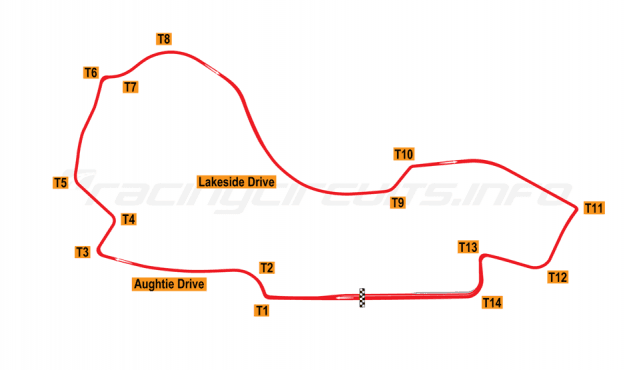
A decade on and the track surface was in need of resurfacing work, so the opportunity was taken to make some revisions to the layout with the aim of enabling more overtaking opportunities and promoting faster and more competitive racing. The works were overseen by motorsport engineering firm iEDM.
Seven corners have seen revisions during the early part of 2021, with two corners eliminated altogether. At Turn 1, the circuit has been widened to driver’s right by 2.5 metres to promote better lap one overtaking options, while Turn 3 has seen widening up to 4 metres on the inside.
Turn 6 sees an even more significant widening, with the inside of the turn moved by 7.5 metres. This will create the largest speed change on the circuit; the current F1 minimum speed of 149 km/h is expected to be 219 km/h in 2021.
The chicane at Turns 9 and 10 have been removed altogether, creating the longest straight on the circuit and a new DRS zone. The original circuit’s Turn 13 (Turn 11 of the revised circuit) sees significant changes, with Ross Gregory Drive realigned and a slight extension of Lakeside Drive to create a tightened corner, which is three metres wider on the inside.
From there the drivers complete the lap as before until the reach penultimate turn, which has been widened by 3.5 metres to create a more flowing set of corners.
Camber changes to the new Turn 3, 11 and 13 to provide multiple driving lines, as well as a slightly widened pit lane, complete the modifications.
Layouts
Configurations at Melbourne GP Albert Park
Melbourne GP Albert Park runs in 4 configurations.
| Layout | Length |
|---|---|
| Supercars Circuit | 3.30 mi · 5.30 km |
| GP Circuit 1996–2020 | 3.29 mi · 5.29 km |
| Current | 3.28 mi · 5.28 km |
| Grand Prix CircuitPrimary | 3.30 mi · 5.30 km |
Gallery
Photos of Melbourne GP Albert Park
Leaderboard
Fastest laps at Melbourne GP Albert Park
Each driver’s best clean lap, ranked — recorded with Pace on the phone, no extra hardware.
No recorded laps yet
Record a session at Melbourne GP Albert Park with Pace and your laps post here — the fastest clean lap per driver, ranked.
Sessions
Recent sessions at Melbourne GP Albert Park
No sessions shared yet
Public sessions recorded at Melbourne GP Albert Park — video, telemetry and lap times — will show up here.
Be one of the first on the track.
Telemetry, live streaming, and a front-row seat for everyone who follows you — free, on the phone you already own. Join the waitlist and invite friends to move up the grid.
Free on iPhone · Android coming