
Spain
Calafat
The Circuit de Calafat was Spain's second permanent motor racing circuit (after Jarama) and opened in 1974.
The track
About Calafat
The Circuit de Calafat was Spain's second permanent motor racing circuit (after Jarama) and opened in 1974. While always primarily focused on motorbike racing, it has and continues to hold regional car racing, though the circuit's importance has faded in recent decades with the rise of the new modern circuits which have sprung up across the country. However, a recent resurgence has been experienced as a Formula E testing base, thanks to a variety of circuit alterations.
Construction began on the Calafat circuit early in 1974 and progressed through the summer ready for inauguration on September 29 when it held a race for Formula Seat 1800 single seaters. Being located close to the sea, the 1.551 miles / 2.496 km track was largely flat; the sea wind often brought sandy dust onto the circuit, while run off areas were fairly minimal. But while facilities were relatively primitive, there was a sense of pride that the region now had a centre to develop its talent.
Calafat would go on to be a cradle for the early careers of future Spanish Grand Prix motorcycle stars Angel Nieto, Jorge Martínez, Sito Pons, Joan Garriga, Carlos Cardus and Alex Crivillé, while Carlos Sainz and Pedro de la Rosa also saw four wheeled action here (in Sainz's case, at the wheel of a Formula Ford, prior to embarking on his successful rally career).
Things were not entirely rosy behind the scenes, however, and in 1982 financial and other legal difficulties engulfed the operating company and the circuit closed. In 1983, the local courts awarded ownership of the circuit to the municipality of L'Ametlla de Mar, with Calafat SA granted a 50 year lease to run the facility on behalf of its new public owners.
The circuit reopened in 1983, though not before some safety upgrades had been made, with Turns 5 and 6 repositioned to create greater run-off, with the original section being abandoned altogether. This reduced the lap distance to 1.429 miles / 3.200 km.
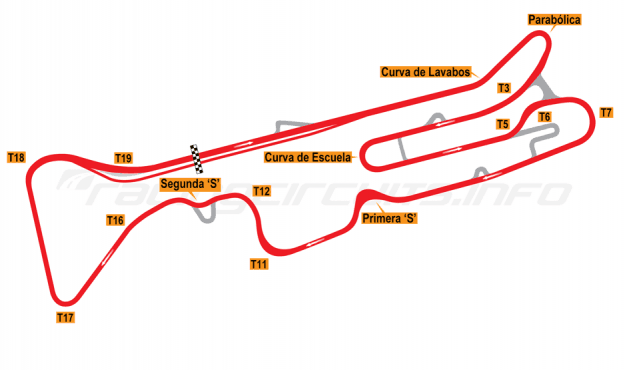
In the 1980s and 1990s Circuit de Calafat was the venue of the Spanish Copa Citroën and national motorcycle competitions but by the end of the decade it was clear that further investment would be needed if the circuit was to have any chance of keeping pace with the other Spanish circuits. With funding from the Government of Catalonia, extensive remodelling was carried out, which resulted in a new loop being constructed in the infield, extending the length to over two miles for the first time. In addition, the final turn was made shallower, creating more of sweeping corner and moving the racing line further away from the pit wall to aid safety.
In its new form, the circuit once again assumed its position as an important regional venue, though the need to continue to upgrade for the latest in safety requirements has seen the circuit struggle to maintain its position. It lost its motorcycle competition license altogether, though thanks to a complete resurfacing in November 2008 and continuing works to upgrade pit facilities, curbing and run-off areas, it regained its licence from the Catalan Federation of Motorcycles in 2012, though not from the national authorities. The track continues to be licensed by both for four-wheeled competition, however.
Today the majority of track action is for private testing, track days and for the Catalonian regional car and motorcycle championships. Notable users in 2015 were the NextEV by TCR and Mahindra Formula E teams, who used Calafat to begin their testing for the 2015/2016 Championship. Spanish driver Antonio García was at the wheel for NextEV while Bruno Senna took to the Mahindra for the tests.
In a bid to make the track even more attractive to Formula E teams, the circuit underwent modifications for 2016, which saw the insertion of three new chicanes, built using Formula E-style kerbing. This made the circuit more representative of the tight and twisty street circuits the all-electric championship favours. All three were named after Formula E teams.
The gambit worked, with the circuit becoming a regular off-season test centre for Formula E teams, with the circuit also welcoming the Eco Grand Prix in 2017, a six-hour endurance race for standard electric road cars.
Also included with the changes was the Variante Doble Curva, which created new 'Outer' and 'Inner' circuit variations, meaning there were now four courses in regular use.
In 2018, further revisions were made to the Formula E course, with the bypassing of the Curva de Escuela with two 90-degree corners, plus a new hairpin and left-right corner complex which cut out Turns 5-6-7 of the main course. A further chicane was added to create a tighter variation of the Segunda S. Again, the circuit made the changes to attract further testing opportunities. This paid off when the entire Formula E paddock turned out in April to test their new 'Gen 2' cars. The following year also saw a test by the Porsche Formula E squad.

Layouts
Configurations at Calafat
Calafat runs in 4 configurations.
| Layout | Length |
|---|---|
| Full circuitPrimary | 2.02 mi · 3.25 km |
| Outer circuit | — |
| Formula E test circuit | — |
| Inner circuit | — |
Gallery
Photos of Calafat
Leaderboard
Fastest laps at Calafat
Each driver’s best clean lap, ranked — recorded with Pace on the phone, no extra hardware.
No recorded laps yet
Record a session at Calafat with Pace and your laps post here — the fastest clean lap per driver, ranked.
Sessions
Recent sessions at Calafat
No sessions shared yet
Public sessions recorded at Calafat — video, telemetry and lap times — will show up here.
Be one of the first on the track.
Telemetry, live streaming, and a front-row seat for everyone who follows you — free, on the phone you already own. Join the waitlist and invite friends to move up the grid.
Free on iPhone · Android coming